
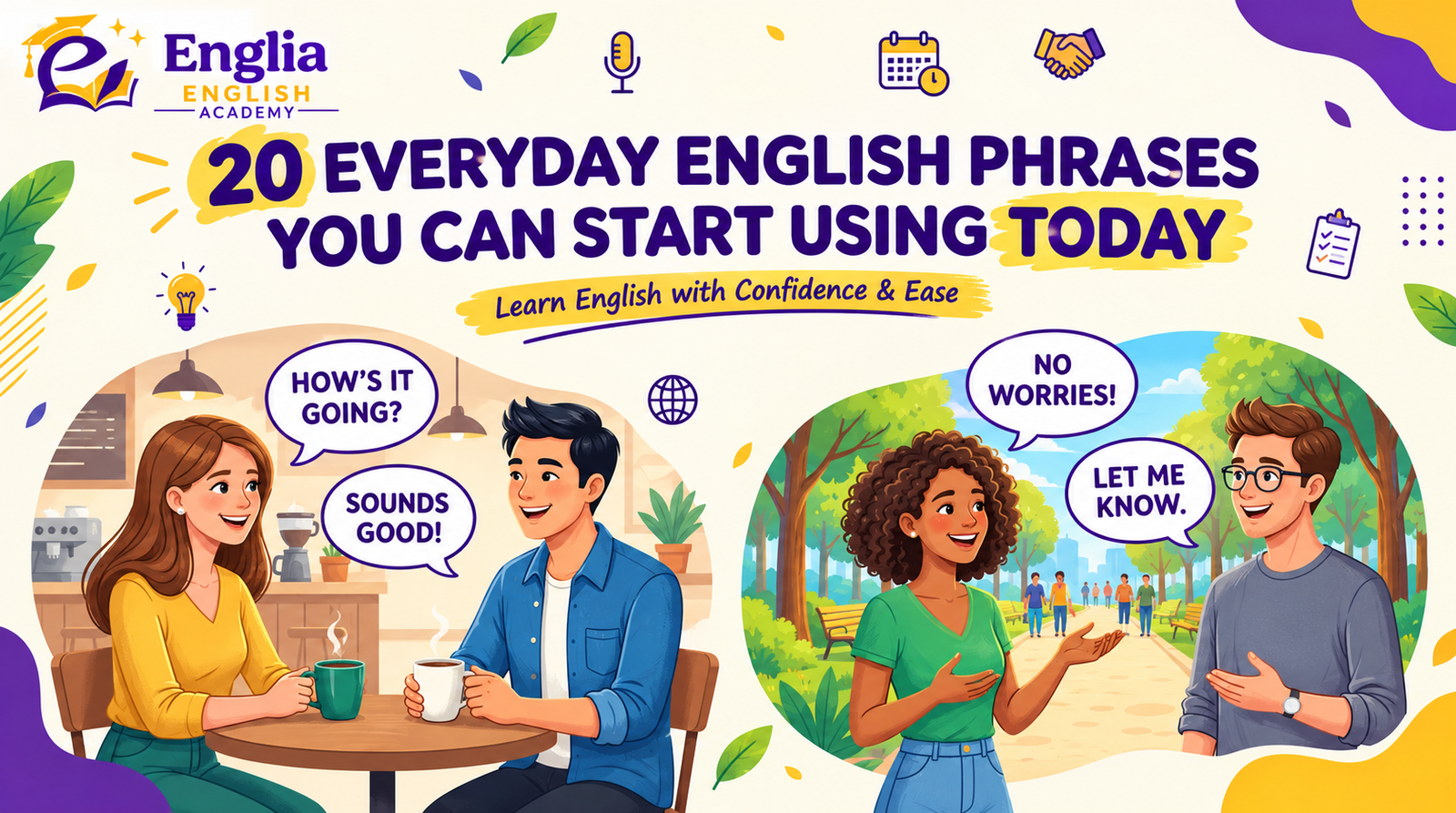

Everyday English phrases can make your conversations sound more natural and help you communicate more confidently. You may already know many English words, but knowing how to put them together in common expressions can make speaking much easier.
Here are 20 useful phrases you can start using in your daily conversations.
1. How’s it going?
A casual way to ask someone how they are or how things are going.
Example:
“Hey, how’s it going?”
2. Sounds good
Use this when you agree with a suggestion or plan.
Example:
“Let’s meet at 6.”
“Sounds good.”
3. That makes sense
Use this when you understand or agree with someone’s explanation.
Example:
“Oh, you were busy at work? That makes sense.”
4. I’m not sure
Use this when you don’t know something or don’t want to give a definite answer.
Example:
“I’m not sure what time she’ll arrive.”
5. It depends
Use this when the answer changes according to the situation.
Example:
“Are you going to the party?”
“It depends on how much work I have.”
6. No worries
A friendly way to say that something is okay.
Example:
“Sorry I’m late.”
“No worries.”
7. Give me a second
Use this when you need a short amount of time.
Example:
“Can you help me?”
“Sure. Give me a second.”
8. I’ll get back to you
Use this when you need to check something before giving someone an answer.
Example:
“I need to check my schedule. I’ll get back to you tomorrow.”
9. Let me know
Use this when you want someone to tell you something later.
Example:
“If you need any help, let me know.”
10. I’m looking forward to it
Use this when you are excited about something that will happen in the future.
Example:
“I’m really looking forward to our trip.”
11. Take your time
Use this when you want someone to know that they don’t need to hurry.
Example:
“Take your time. I can wait.”
12. I have no idea
Use this when you really don’t know the answer.
Example:
“Where is David?”
“I have no idea.”
This is stronger than simply saying “I’m not sure.”
13. That sounds great
Use this when you like an idea or suggestion.
Example:
“Would you like to have dinner together?”
“That sounds great.”
14. I’m afraid I can’t
A polite way to say no when you cannot do something.
Example:
“Can you join us tonight?”
“I’m afraid I can’t. I have to work.”
15. What do you mean?
Use this when you don’t understand what someone is trying to say.
Example:
“What do you mean? Could you explain that again?”
16. It’s up to you
Use this when you want another person to make the decision.
Example:
“Where should we eat?”
“It’s up to you.”
17. I’ll think about it
Use this when you need some time before making a decision.
Example:
“Would you like to take the course?”
“I’ll think about it.”
18. That’s a good point
Use this when someone says something that you think is reasonable or worth considering.
Example:
“We should leave early because of the traffic.”
“That’s a good point.”
19. By the way
Use this when you want to introduce another topic or add some extra information.
Example:
“By the way, did you talk to Sarah?”
20. See what I mean?
Use this when you want to check whether someone understands your point.
Example:
“English becomes easier when you practise regularly. See what I mean?”
How to Remember These Phrases
Don’t try to memorise all 20 phrases in one day.
Choose three or four phrases that you can actually use in your daily life. Write your own examples and try to use the phrases when speaking English.
For example, if you learn “It depends,” look for opportunities to use it:
“It depends on the weather.”
“It depends on my schedule.”
“It depends on the price.”
The more you use a phrase in different situations, the easier it becomes to remember.
Start Using English, Not Just Studying It
Learning individual words is important, but English becomes much more useful when you can use those words naturally in conversations.
The next time you have an English conversation, try using one or two of these everyday English phrases. You don’t need complicated vocabulary to sound natural. Sometimes, simple expressions are exactly what you need.
Keep practicing, keep speaking, and gradually make English part of your everyday communication.
The fastest way to make these phrases yours is to use them in real conversation. Learn more about our 1-on-1 English classes for adults.
