
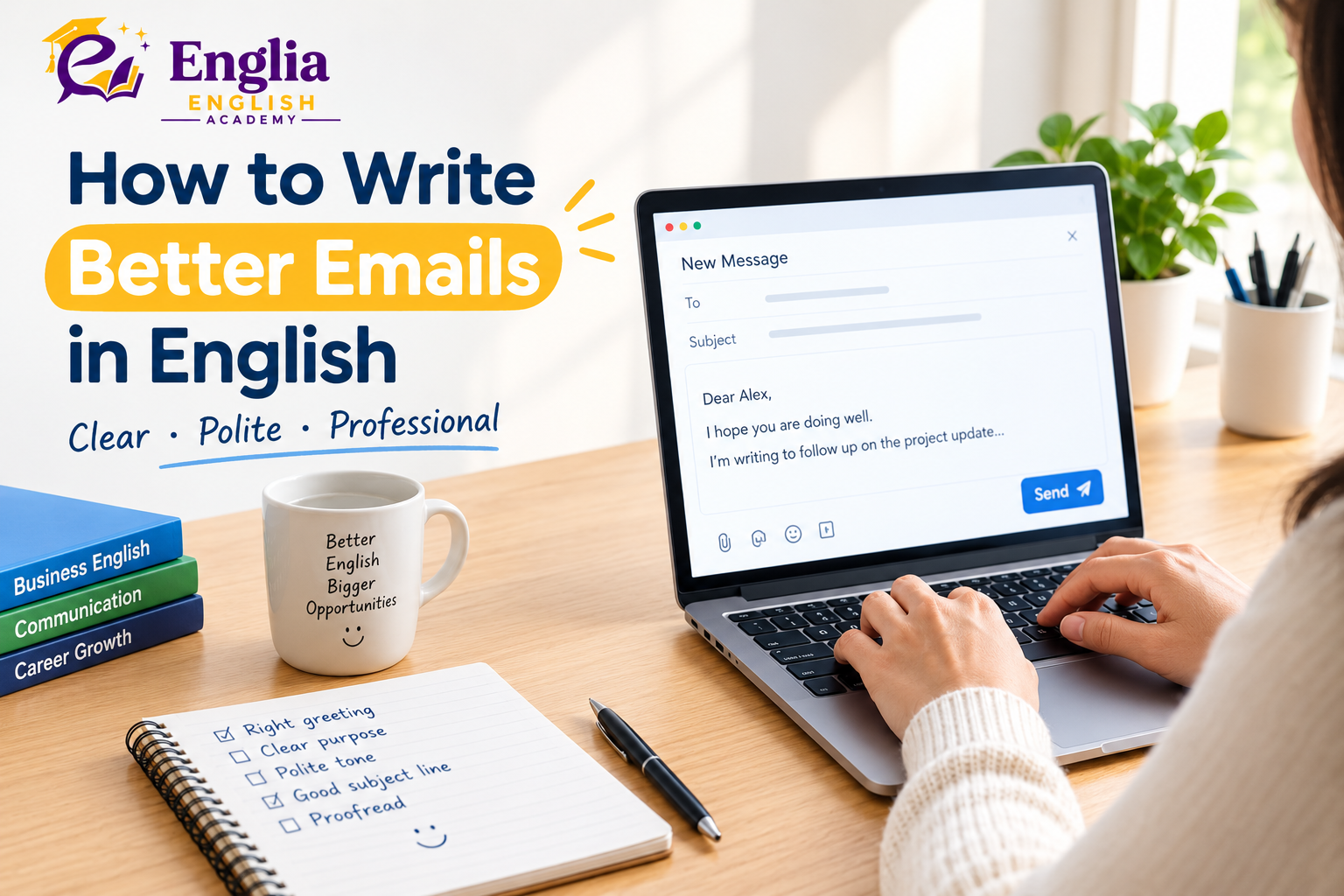

Writing an email in English can be challenging, especially when you need to communicate with a manager, client, colleague, or someone you have never met before. You might know exactly what you want to say, but choosing the right words and tone can be difficult.
A professional email should be clear, polite, and easy to understand. You don’t need complicated vocabulary or long sentences to make a good impression. In fact, simple English often works best.
In this guide, you’ll learn how to structure a professional email, adjust your tone depending on the situation, and avoid common mistakes that can make your writing sound too casual or unnecessarily formal.
1. Start With the Right Greeting
Your greeting sets the tone for the rest of your email. The best choice depends on how well you know the recipient and the type of relationship you have with them.
For example, if you’re contacting someone for the first time, “Dear Ms. Smith” is a safe professional option. If you regularly communicate with a colleague, “Hi Sarah” may feel more natural.
Here are some examples:
- Dear Mr. Johnson, — formal communication with someone you don’t know well.
- Dear Hiring Manager, — job applications when you don’t know the recipient’s name.
- Hello Sarah, — polite and professional in many workplace situations.
- Hi James, — friendly and appropriate for regular communication with colleagues.
Avoid starting a formal business email with “Hey!” unless you already have a very casual relationship with the recipient.
Tip: When someone emails you using your first name, you can usually use their first name in your reply.
2. Make Your Purpose Clear From the Beginning
One common email mistake is taking too long to explain why you’re writing. A professional email should help the reader understand its purpose quickly.
Compare these two examples.
Less effective:
“I hope you are doing well. I wanted to write to you today because there is something I have been thinking about regarding the meeting we had last week, and I wanted to ask you a question.”
More effective:
“I’m writing to clarify two points from last week’s meeting.”
The second version is shorter and tells the reader exactly what to expect.
Here are some useful opening sentences for different situations:
- To request information: “I’m writing to ask about the upcoming training session.”
- To follow up: “I’m following up on my previous email regarding the project.”
- To provide an update: “I’d like to share a quick update on the project.”
- To explain a problem: “I’m writing to let you know about an issue with the latest report.”
Choose an opening that matches your purpose instead of using the same sentence in every email.
3. Be Polite Without Sounding Too Formal
Professional communication requires politeness, but that doesn’t mean every sentence needs to sound formal or complicated.
For example, if you need a colleague to send you a document, you could write:
Too direct: “Send me the report today.”
Professional: “Could you please send me the report by the end of the day?”
The second version makes the request politely while keeping the deadline clear.
However, you don’t always need to add “please” to every sentence. A clear, respectful request is usually enough.
Consider these examples:
- Instead of “I want the details,” write “Could you share the details with me?”
- Instead of “You didn’t answer my question,” write “I wanted to follow up on my question below.”
- Instead of “You need to fix this,” write “Could you take another look at this issue?”
The goal is not to make your message sound weak. It’s to communicate your needs without creating unnecessary tension.
4. Learn How to Make Requests at Work
Making requests is a normal part of professional communication. You may need information, approval, feedback, or assistance from someone else.
The important thing is to explain what you need and, when relevant, why you need it.
Example: Requesting feedback
Subject: Feedback on the Project Proposal
Hi Sarah,
I’ve attached the project proposal for your review. Could you share your feedback by Thursday so I can make the necessary changes before the meeting?
Thank you for your time.
Best regards,
Alex
Notice that the request includes the document, the action required, and the deadline. This makes it easier for the recipient to respond.
When making a request, avoid being so indirect that the reader cannot tell what you need. Politeness should make your message easier to receive, not harder to understand.
5. Choose a Subject Line That Explains the Email
A useful subject line tells the recipient what the email is about before they open it.
Avoid vague subjects such as:
- Hello
- Important
- Question
- Update
These subjects don’t provide much information, especially when someone receives dozens of emails each day.
Instead, try writing specific subject lines:
- Meeting Confirmation – 24 October
- Request for Project Feedback
- Updated Invoice for September
- Follow-Up on Job Application
- Training Schedule for November
A good subject line is usually short and specific. If the recipient needs to take action, make that clear in the subject when appropriate.
6. Know When to Use Formal and Informal English
Not every professional email needs the same tone. An email to a potential employer will usually sound different from a quick message to a teammate.
Compare the following examples.
| Situation | Suitable wording |
|---|---|
| Contacting a new client | “Dear Ms. Brown, I’m writing regarding your recent inquiry.” |
| Emailing a regular colleague | “Hi Daniel, here’s the update we discussed.” |
| Requesting assistance from a manager | “Could you advise me on the next steps?” |
| Confirming a plan with your team | “Just confirming that we’re meeting at 2 p.m.” |
The relationship, company culture, and purpose of the message all influence your choice of language.
When you’re unsure, begin with a polite, neutral tone. You can become more conversational as you get to know the recipient.
7. Replace Unclear Sentences With Specific Information
A professional email should reduce confusion, not create more questions.
Consider this message:
“I’ll send it soon.”
What does “soon” mean? Later today, tomorrow, or next week?
A clearer version would be:
“I’ll send you the revised document by 3 p.m. tomorrow.”
The same principle applies when discussing problems or deadlines.
Unclear: “There is a problem with the file.”
Clearer: “The file won’t open on my computer. Could you resend it as a PDF?”
Unclear: “I’ll get back to you later.”
Clearer: “I’ll review the proposal and get back to you by Friday.”
Whenever possible, replace vague expressions with specific actions and time frames.
8. Disagree Without Sounding Rude
You may need to disagree with a suggestion, question a decision, or point out a mistake. In professional emails, the way you express disagreement can influence how the message is received.
For example:
Too blunt: “This plan won’t work.”
More constructive: “I have some concerns about this approach. Could we consider an alternative?”
You can also acknowledge the other person’s idea before explaining your concerns.
Example:
Hi Michael,
Thank you for sharing the proposed schedule. I understand why this approach could be useful, but I’m concerned that the current deadline may not allow enough time for testing.
Could we discuss extending the timeline by two days?
Best regards,
Emma
This message explains the concern and suggests a possible solution instead of simply rejecting the idea.
Being professional doesn’t mean agreeing with everyone. It means expressing your opinion respectfully and focusing on the issue rather than the person.
9. End Your Email Naturally
Your closing should match the tone of your message and your relationship with the recipient.
Here are some common options:
- Best regards, — a reliable choice for most professional emails.
- Kind regards, — polite and slightly warm.
- Thank you, — suitable when expressing appreciation or requesting assistance.
- Best, — concise and friendly, especially with familiar colleagues.
- Sincerely, — often used in formal correspondence, including some job applications.
For example:
Thank you for your time and consideration.
Best regards,
Apeksha
You don’t need a long closing paragraph. A brief expression of appreciation followed by an appropriate sign-off is often enough.
10. Check Your Email Before Sending It
Even a well-written email can cause problems if it contains an incorrect date, missing attachment, or unclear request.
Before clicking Send, take a moment to check the following:
- Purpose: Is the reason for the email clear?
- Tone: Does the message sound respectful and appropriate?
- Details: Are names, dates, deadlines, and figures correct?
- Attachments: Have you attached the files you mentioned?
- Action: Does the recipient know what they need to do?
- Grammar: Have you checked spelling, punctuation, and sentence structure?
Reading your email once before sending it can help you catch mistakes that you might otherwise overlook.
Practice: Improve This Professional Email
Let’s put these ideas into practice.
Imagine that you need a colleague to send you a report before a meeting tomorrow.
Here’s an email that could be improved:
“Hi, I need the report. Send it quickly because the meeting is tomorrow. Thanks.”
How could you make it more professional?
One possible revision is:
Subject: Report Needed for Tomorrow’s Meeting
Hi Daniel,
Could you please send me the report by the end of today? I’d like to review it before tomorrow’s meeting.
Thank you for your help.
Best regards,
Alex
The revised email explains the request, gives a deadline, and maintains a polite tone without adding unnecessary words.
Try rewriting the original email in your own words. There may be several good answers, depending on your relationship with the recipient and how urgent the request is.
Final Thoughts
Writing professional emails in English is a skill that improves with practice. You don’t need to use advanced vocabulary in every sentence or follow rigid rules for every situation.
Focus on three things: clarity, politeness, and purpose. Make your request easy to understand, choose a tone that suits the recipient, and remove anything that doesn’t help communicate your message.
At Englia English Academy, we believe that practical English skills can help learners communicate more confidently in their professional lives. Whether you’re writing to a client, responding to a manager, or contacting a potential employer, learning to write clear emails can make everyday work communication easier.
Start with one email at a time, apply these principles, and gradually develop a professional writing style that feels natural to you.
Want to practise writing and speaking professional English with a teacher? See our Business English classes or book a free trial class.
